Record yourself
I'm 46. I recently found a journal from when I was 16. I've journaled in college-ruled notebooks, in moleskines, on index cards, on unlined white paper. I've journaled in pencil, fountain ink, and, when nothing else is available, ball point pens. I've used at least all of these softwares for collecting my notes: Lotus Notes, OneNote, Evernote, Roam Research, Notepad, MS Paint, Obsidian. There is a compulsion in this much recording.
Why take notes?
I write notes because I feel compelled to. I could say that I have an intellectual need to understand things by pulling out a few lines from what I read. I could say that I often only recognize the trends of my own behavior, my emotions and feelings, or even what I believe in, by seeing it on a page or a screen, just after I typed it. I could say that there is a feeling that something is working through me to get into keystrokes or pen strokes. But honestly, those are tarted up ways to say it. I have to write notes.
The second way, the slightly more sane way, is what happens to those notes when I review. My notes are the most honest version of who I have been, what I have done, how I have done, what I said to whom. And I'm often surprised at what I have recorded.
And just as surprising, more recently, I have started to see the writer of these past notes as more empathetic, more understandable, mostly by reading his notes. That's a new blessing.
JC, age 23
I am increasingly understanding my own history as explainable and even relatable. For many years, I was embarrassed by my past. The story I carried around of my 20s and 30s was about destruction and harm. In re-reading those notes, I see some of the incidents that gave me this impression of being a very lost soul; but I also see tenderness, and I see someone trying to reconcile a life that is unfolding, with the skills that I had. I see lies, to my self and to others. I also see apologies. I see unassuredness inwardly while seeing a projection of confidence. I see a lostness.
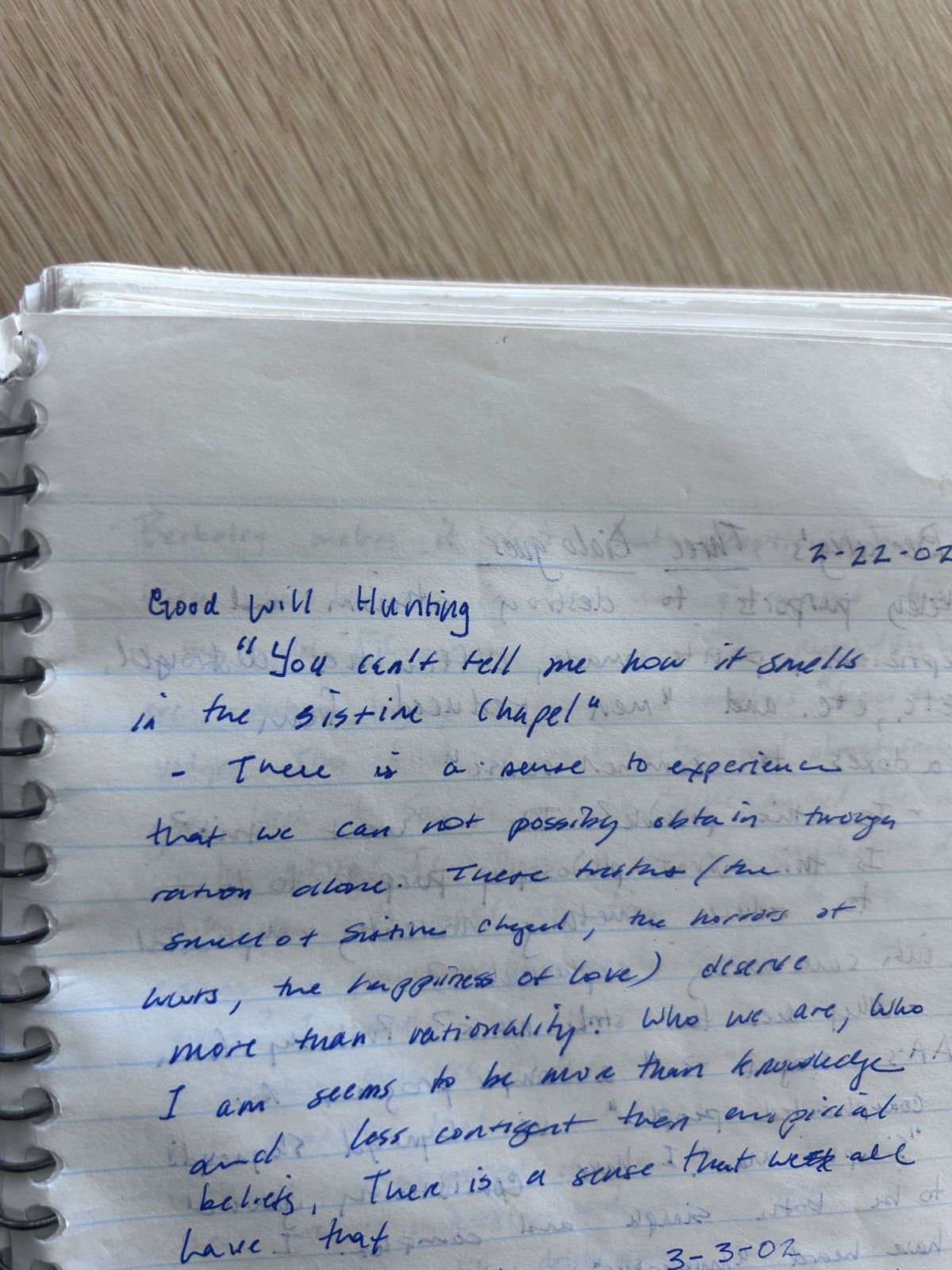
I also see a wonder and a knowing. This note from 2002 says that experience can't be thought into or even read into, from a relatively bookish and inexperienced 23 year old. I have no idea what made me write that down. I must have known that there was some truth to it. And yet, I couldn't have known what it meant then in the way that I know what it means now.
Recovery
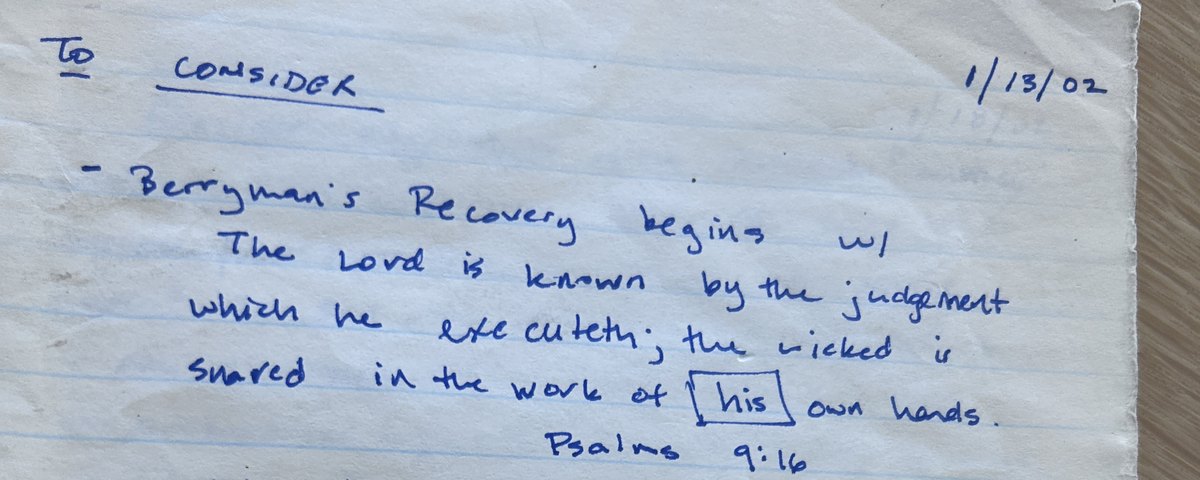
I think Severance (it's been 24 years since I read the book) is delusional; I am still so, but I can see the delusion now, at least mostly see it, see it more quickly and more fully. The delusion hasn't quite stopped, I still find myself worried about what unnamed masses will think of me, when I know that the answer is nothing, no one is ever thinking of you. But I can see that worry for what it is now too.
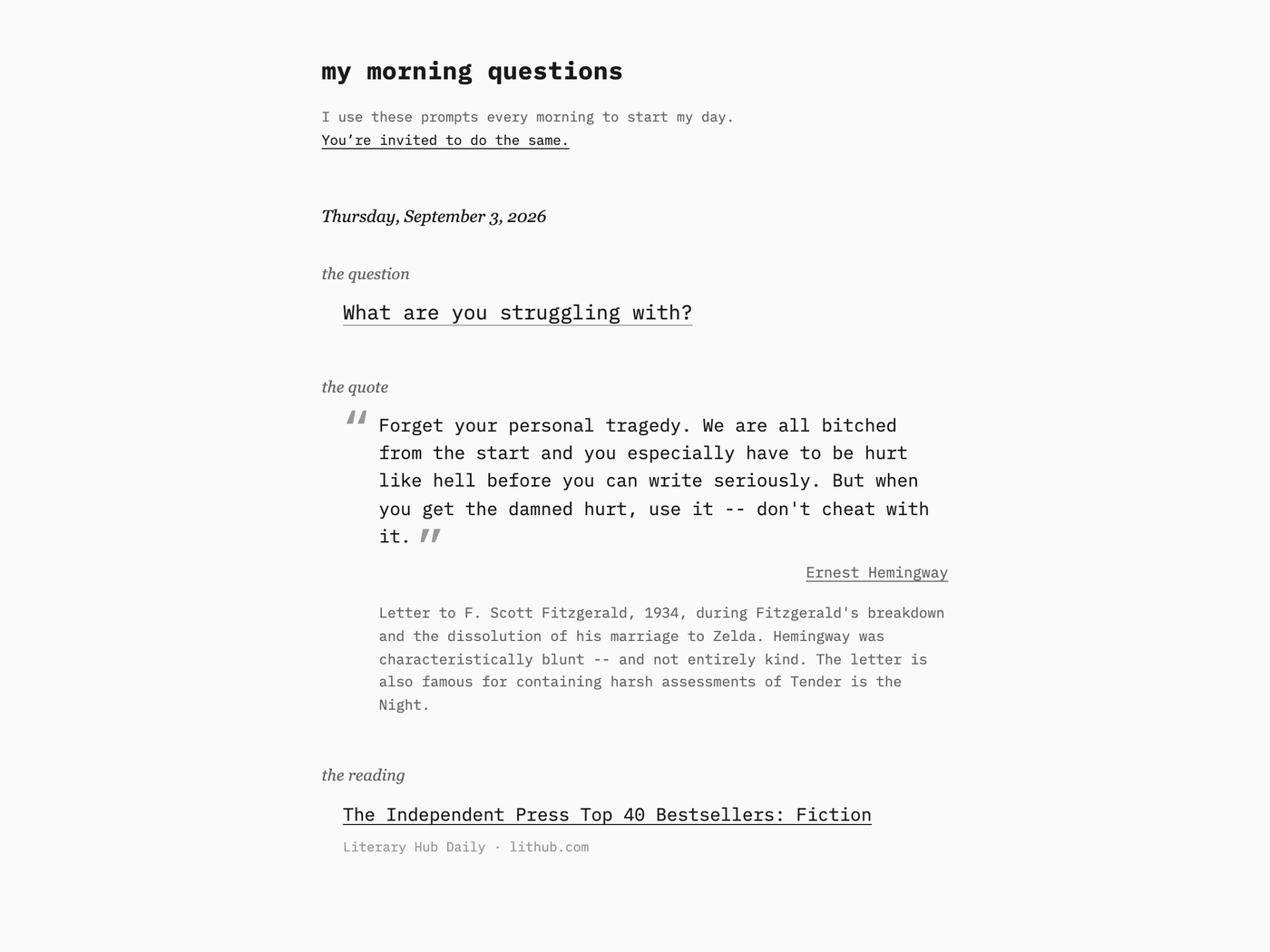
My morning questions, circa 2020
Well it's important to say that the practice of writing down what you're grateful for isn't mine; I didn't originate it. No one owns it. Many others have very successful systems that feature it. There are some very successful commercial applications of it. There are likely more sophisticated practices than mine.
Here's what's working for me now:
Writing three things I'm grateful for. The 'things' have changed dramatically in the ~9 years I've done this. At first, I just wrote what was happening to me, but tacked on "I am grateful".
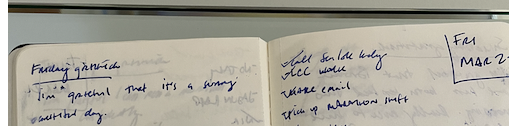
Then I began to really search for a feeling of gratefulness and write about what I saw as the object of that feeling. I'm grateful for this roof, because I feel secure and safe, something like that.
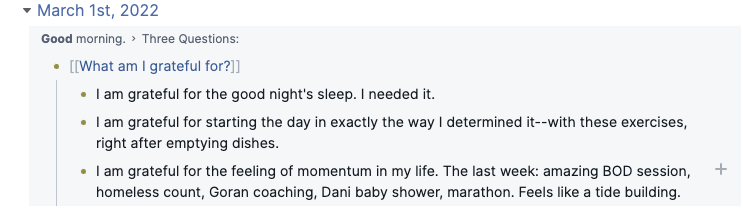
And now, I'm back to where I started.
My kids are 13 and 5 and they got pet ducks this past summer. And I'm grateful when I have to clean up duck shit. I should say I don't like it. It smells and it's my kids' pets so I feel put upon when I clean up. And there is a seemingly infinite amount of it.
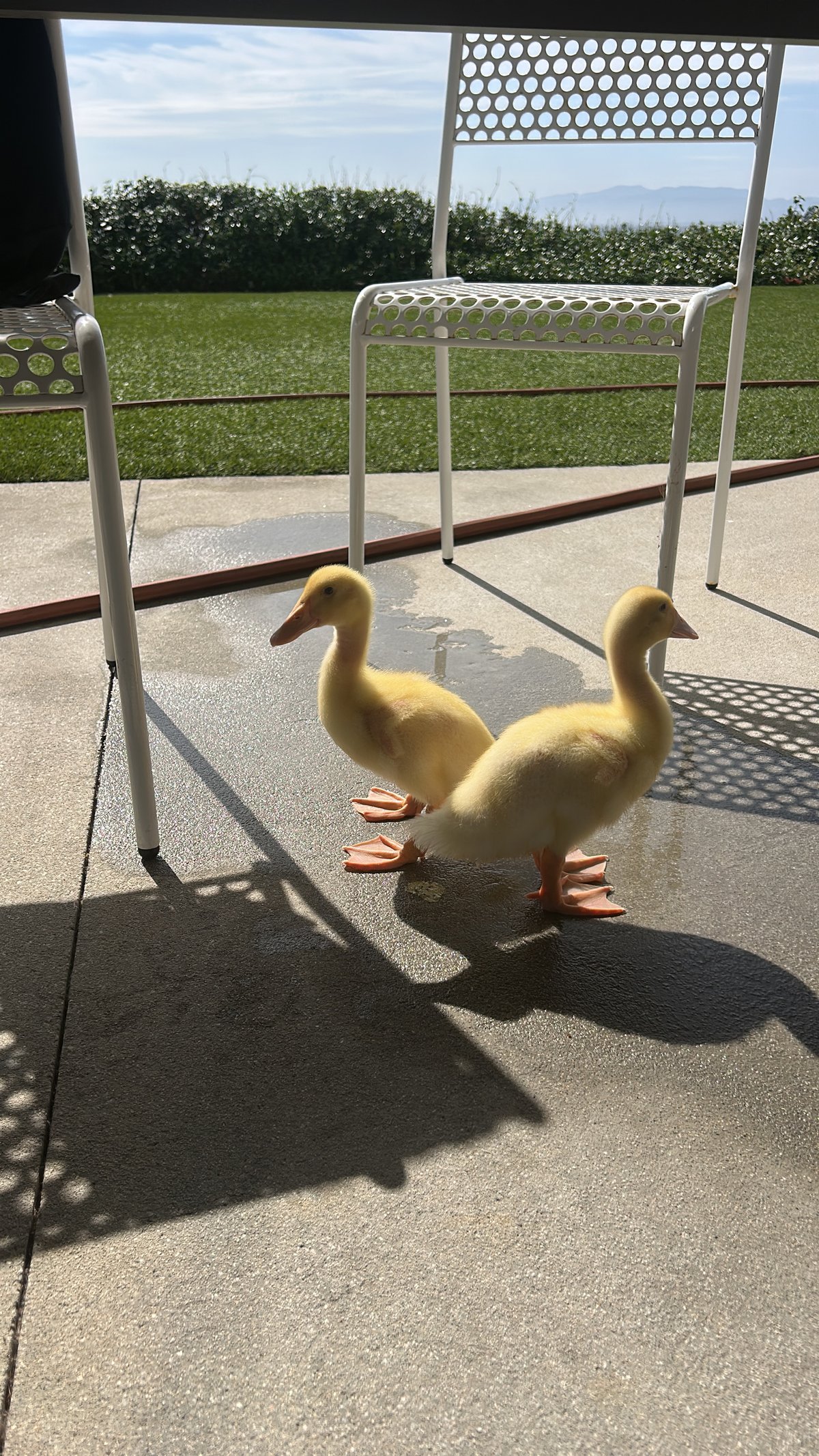
But I'm grateful for my life, which this is part of. And I can feel that gratitude, that warmth and that internal ease, yes, even around duck shit.
How it works now
The practice evolved from the gratitude prompt: What are you grateful for? To even more questions. At times, I answered the same questions. Then I began to rotate through a few. Then I began to randomize them. And now I think it's some version of a single question, randomized.
Then the practice added some historical reflection. I pulled in my old notes from that day. Then my old emails; these are a goldmine, so much detail here. And it also helped my LLM friends for context and rounding out stories. Finally, I added photos from this day.
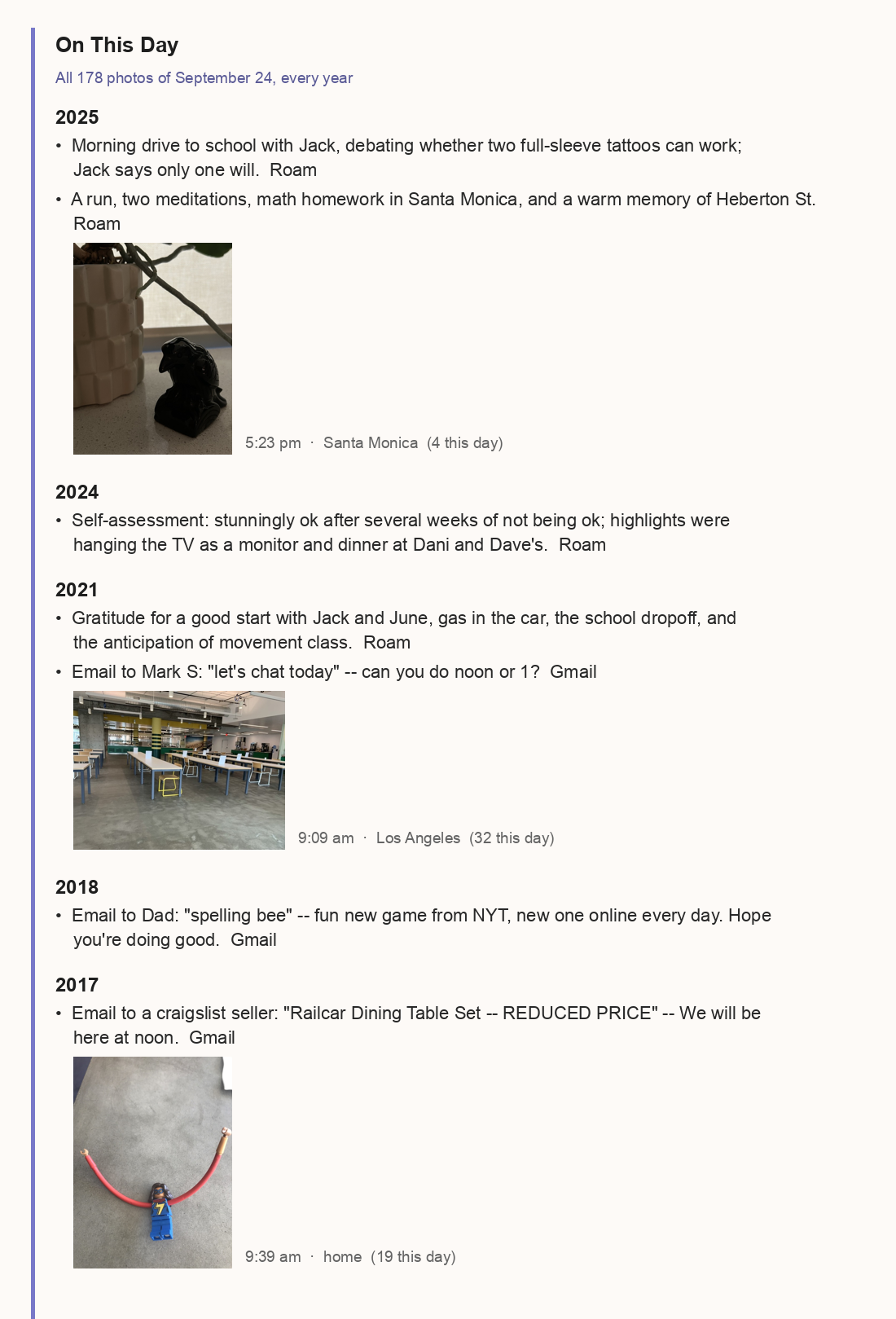
And then, I added a way to experience awe and connection in the practice. This step was inspired by David Whyte, who said he looked at the world BBC weather map every day, to see how the weather was building up on the Pacific and what that meant for tiny old UK. I thought that was a good practice and have found a menagerie of other funny sites to add to the rotation, some producing awe, some new knowledge and occasionally a point of view or a helpful reading.
The systems
I took Tiago Forte's Building a Second Brain course in 2021; it was part task management, part information architecture and Tiago was open and honest about how his system had been changing. I found it compelling, implemented it, and almost immediately modified it to fit my needs.
In 2023, Tiago asked some of his old students to facilitate new cohorts, which I did. I taught Building a Second Brain to hundreds of people. It was fulfilling; old notes can compound, like long-term investing. Sharing that with people is special.
The systems will always work until they don't. I take the systemic failures less personally now. I don't think a tool will save me.
My current setup is dependent on LLMs and a relatively scotch-taped series of scripts, prompts, html and git repositories. I don't like to admit it, but it will likely stop working at some future point. But it works now, and I spend less time working on the system and more time working in the system.
My morning questions, circa 2026
Here's now what I do. I built a website that mimics the most legible parts of my old systems. This will work, for at least the next few minutes.
The instructions are simple. Pull up the website. Sit quietly. Ask yourself what you're grateful for. Write it down, exactly as it comes in. This is harder than it may sound. Don't stop until you have it, or at least, the big parts. And then click through. Ask yourself a funny question and write the honest answer. Look at who you were, who you really were, 5 years ago, 20 years ago if you can. See something amazing. That's it. Come back tomorrow, see how it (and you) have changed.